Assessment usually shows up when you're already tired. The lesson is over, the papers are stacked, and now you have to decide what students learned, what was just copied, and what needs reteaching tomorrow. That's why so many teachers end up treating assessment as a grading event instead of a teaching tool.
That approach misses what assessment can do. Assessment works best when it gives you usable evidence while there's still time to act on it. Education groups now frame assessment as something used before, during, and after learning to measure progress toward standards and guide instruction, interventions, resource use, and school reporting, as explained by Education Commission of the States on student assessment. In practice, that means a strong assessment system doesn't just sort students at the end. It helps you teach better in the middle.
There's also been a bigger shift in the field. Policy discussions describe a move from traditional end-of-year testing toward through-year assessment models that use multiple tests across the year to build a summative score, reducing reliance on one high-stakes exam while still supporting accountability, according to American Progress on K-12 assessment trends. For classroom teachers, that reflects a broader truth. We're no longer just measuring learning after instruction. We're measuring it during instruction too.
If you're looking for a practical example of assessment in education, these are the methods I'd keep in the toolkit. Each one has a clear use case, a sample task, a quick rubric idea, alignment notes, and differentiation tips you can use right away.
1. Formative Assessment (Ongoing Classroom Checks)
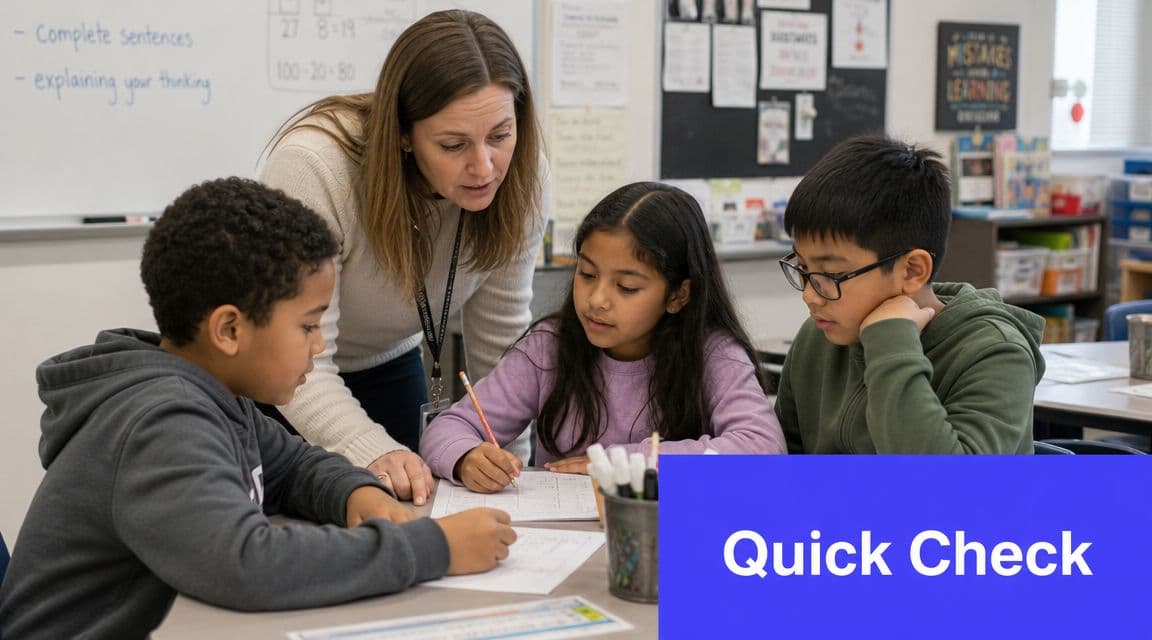
Formative assessment is the quickest way to stop guessing. You ask for evidence during the lesson, not after the unit is over. If you use it well, you catch misunderstandings while students still have time to fix them.
A lot of teachers already use formative checks, but the weak version is just doing an activity because it feels engaging. Entrance tickets, think-pair-share, whiteboards, and 3-2-1 reflections are common examples, yet they only become useful when they lead to a decision about reteaching, pacing, or differentiation, as discussed in NWEA's formative assessment strategies. If you want a clean breakdown of the role this plays alongside end-of-unit grading, Kuraplan's guide to formative vs. summative assessment is a practical reference.
Teacher's Toolkit
Sample item: “Solve 3/4 + 1/8 and explain how you know your answer is reasonable.”
Mini-rubric:
- Secure: Correct answer and a clear explanation
- Developing: Partly correct process or explanation
- Not yet: Major misconception or no reasoning shown
Alignment note: Match the prompt to one standard only. If you mix computation, vocabulary, and written justification in one short check, your data gets muddy fast.
Differentiation tip: Let students explain with words, a number model, or a quick sketch. That gives multilingual learners and students who need processing support a fairer way to show thinking.
Practical rule: Don't collect formative evidence unless you already know what you'll do with each likely response.
What works is speed. One focused question. One clear success criterion. One response move from you. What doesn't work is over-grading every tiny check or turning a low-stakes pulse check into a mini test.
If you want a simple extension, Kingdom of English resources on ESL progress tracking offers useful ideas for keeping quick evidence organized in language-rich classrooms.
2. Summative Assessment (End-of-Unit Tests and Exams)
Summative assessments answer a different question. Not “What should I adjust tomorrow?” but “What did students ultimately learn by the end of this stretch?”
They still matter. Traditional summative assessments remain the dominant model for school ratings, grade promotion, and course credit in many systems, which is part of why they carry so much weight, as noted in the earlier policy discussion on assessment trends. The problem isn't summative assessment itself. The problem is when it's the only evidence that counts.
A Better End-of-Unit Test
A solid summative assessment should mirror the actual learning goals of the unit. If the unit asked students to analyze sources, don't end with a test that mostly rewards recall. If the unit emphasized problem-solving, include items that require students to show method, not just final answers.
Sample item: “Read the two short passages on renewable energy. Write one paragraph explaining which source is more convincing and why.”
Mini-rubric:
- Meets standard: Clear claim, text evidence, reasoning
- Approaching: Claim present but weak evidence or explanation
- Below: Summary only or off-task response
Alignment note: Build the assessment from standards first, then draft the questions. Teachers often do the reverse and end up with a test that's neat but misaligned.
Trade-offs Teachers Actually Feel
- Multiple choice is efficient: It's fast to score, but it can hide weak reasoning.
- Short answer shows thinking: It gives better evidence, but scoring takes time.
- Extended response is rich: It's often the strongest evidence, but students need explicit criteria to succeed.
One practical move is to mix formats. Use selected response for broad coverage and one or two constructed responses for depth. If you're trying to reduce grading time without giving up useful evidence, Kuraplan's overview of AI grading tools is worth a look, especially when you're building rubrics and scoring repeated written tasks.
Reassessment also matters. When a student misses the mark, a retake tied to corrected work or targeted practice tells you more than a permanent low score ever will.
3. Performance-Based Assessment (Tasks and Projects)
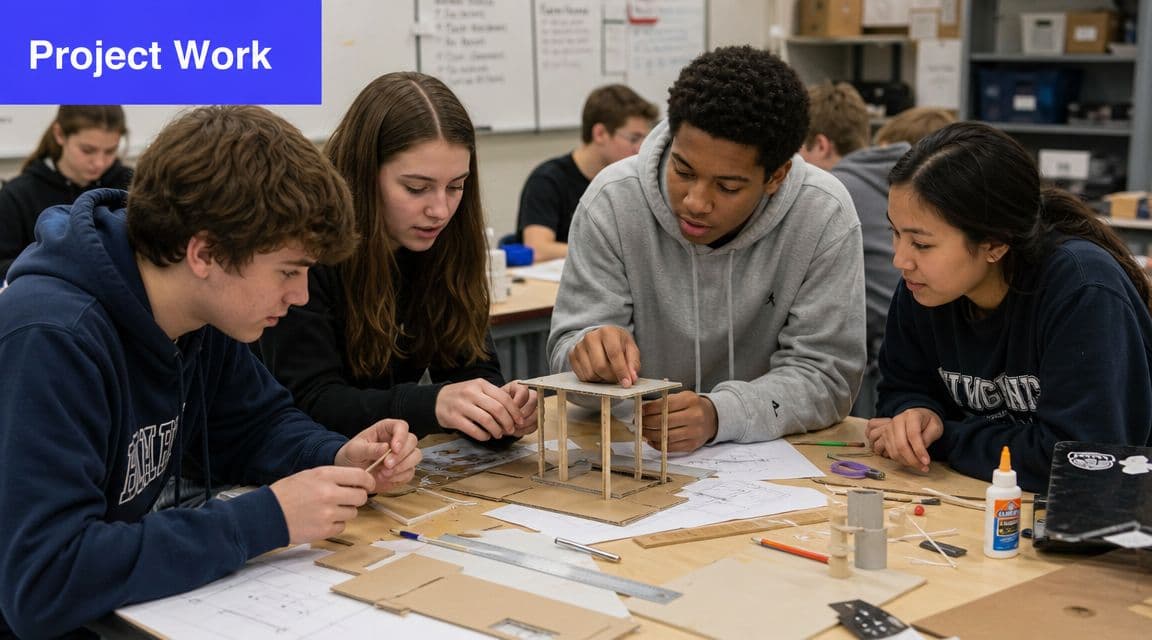
Some learning can't be captured well on a test. You need students to make something, present something, build something, or solve a problem that feels closer to real work. That's where performance-based assessment earns its place.
This is one of the strongest examples of assessment in education when you want evidence of transfer. Students have to apply knowledge, not just recognize it. Done badly, though, projects become arts-and-crafts grading. Done well, they show content mastery, process, and communication.
Teacher's Toolkit
Sample task: Design a water filtration solution for a community after a storm. Students submit a diagram, a written explanation, and a short presentation defending their design choices.
Mini-rubric:
- Content accuracy: Science ideas are correct and relevant
- Application: Design fits the problem and constraints
- Communication: Explanation is clear and supported
- Process: Student documents revisions or testing
Alignment note: Limit the assessed criteria to the standards you taught. If you score neatness, creativity, teamwork, speaking, and content all at once, students won't know what mattered most.
Differentiation tip: Offer options for the final product. Slide deck, poster, recorded explanation, or live presentation can all show the same learning target if your rubric is tight.
What works is checkpoints. Proposal first. Draft or prototype next. Final product last. That prevents the classic project problem where a student disappears for a week and turns in something you can't meaningfully coach.
A quick classroom example helps here:
A strong project rubric doesn't reward the fanciest product. It rewards the clearest evidence of learning.
If you want to see the kind of classroom mindset behind performance tasks, this short video is a useful companion:
Kuraplan can be useful here because project-based units fall apart when the task, standards, and checkpoints aren't aligned from the start.
4. Rubric-Based Assessment (Criterion-Referenced Evaluation)
Rubrics save time only if they're written well. A vague rubric creates more arguments, slower grading, and weaker feedback than no rubric at all.
The best rubrics make quality visible before students begin. They reduce the mystery around “good work” and make teacher feedback more consistent. They also help when multiple teachers score the same kind of assignment.
What a Usable Rubric Looks Like
Sample assignment: Argument essay on whether school uniforms should be required.
Mini-rubric criteria:
- Claim
- Evidence
- Reasoning
- Organization
- Conventions
For each criterion, write descriptors students can understand. “Uses relevant evidence to support the claim” is better than “demonstrates proficiency.” Plain language wins every time.
Alignment note: Four or five criteria is usually enough. More than that, and students stop using the rubric as a guide.
Differentiation tip: Highlight one priority criterion for individual students. One student may focus on organization, another on evidence integration. Everyone can still work from the same full rubric.
What Doesn't Work
- Point-heavy rubrics: They push students to chase totals instead of quality.
- Hidden rubrics: If students see it only after grading, it's not a teaching tool.
- Trait overlap: If “analysis” and “critical thinking” mean almost the same thing, scoring gets sloppy.
For teachers who don't want to build every rubric from scratch, Kuraplan's rubric generator is a practical shortcut. It's especially helpful when you need standards-aligned language but still want to edit for your class voice and grade level.
Students usually improve faster when the rubric sounds like something they'd actually hear in class.
5. Portfolio Assessment (Artifacts and Collections)
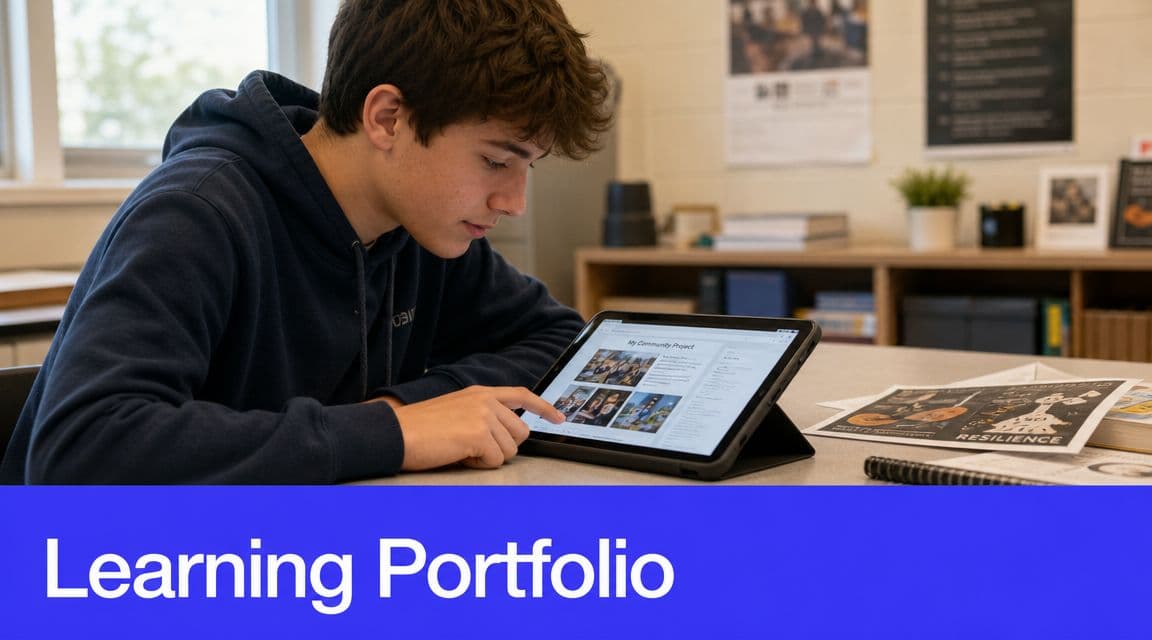
It is late in the grading period, and a parent asks a fair question: “Has my child improved, or just had one good week?” A portfolio answers that better than a single test ever will. It gives teachers a body of evidence across time, which makes it especially useful in writing, reading response, art, project work, and intervention plans.
A portfolio works only when it is curated with a clear purpose. Students need to choose pieces that match a goal, annotate why each artifact matters, and reflect on what changed between the first attempt and the later one. Without that structure, the portfolio turns into storage.
Teacher's Toolkit
Sample portfolio setup: A middle school writing portfolio includes one baseline draft, one revised piece, one on-demand writing sample, one peer-feedback form, and one student reflection.
Sample reflection prompt: “Which piece shows the biggest improvement, and what specific revision choices led to that change?”
Mini-rubric:
- Growth evidence: Work shows development across time
- Selection quality: Chosen pieces match the stated goals
- Reflection: Student explains strengths, needs, and next steps
- Completion: Required artifacts are included
Alignment note: Decide up front whether the portfolio measures growth, mastery, or a mix of both. That decision affects what students collect, how often they reflect, and how you score the final set of artifacts.
Differentiation tip: Let students record reflections orally if writing stamina or language production would hide what they understand about their progress. In language classes, you can also ask students to evaluate your language skills separately, then compare that outside result to classroom samples for a more grounded conversation about performance.
Where Portfolios Earn Their Keep
Portfolios help when one task cannot capture the whole target. A final draft may look polished, but the earlier draft, the revision notes, and the reflection often show the actual learning. That matters if the goal is growth.
They also expose trade-offs teachers need to balance. Portfolios give richer evidence, but they take more time to review and conference. They support student ownership, but only if teachers set tight artifact limits and clear submission rules. In practice, fewer pieces usually produce better evidence because both the student and the teacher can explain the choices.
A useful portfolio might include drafts, final products, teacher feedback, peer feedback, and a short reflection for each checkpoint. That mix gives a fuller picture of performance than a stack of finished assignments with grades attached.
What weakens portfolio assessment is overcollection, vague criteria, and reflections that stay at “I worked hard.” Keep the artifact list short. Ask for specific reflection prompts. Schedule brief conferences during the unit instead of waiting until the end, when it is too late to correct weak submissions.
6. Standardized Testing (State and Benchmark Assessments)
Teachers rarely need a pep talk about standardized tests. What they need is a realistic way to use them without letting them dominate everything.
These assessments give schools a common measure under consistent conditions. They matter for accountability, and many districts also use benchmark versions during the year to predict readiness and identify gaps. That can be useful. It can also distort instruction when every classroom choice starts revolving around probable test items.
Using Benchmark Data Without Letting It Run the Room
A Texas case study shows what structured use can look like in practice. In two districts, curriculum-aligned benchmark assessments given every six or nine weeks across core subjects were used to guide reteaching, place students into interventions using student-level reports, compare grades against benchmark performance to catch false positives, predict state-test performance, and monitor equity across classrooms by teacher and subgroup, according to the Texas benchmark assessment case study.
That's the useful version. The unhelpful version is giving benchmark tests, posting the scores, and moving on.
Sample item: A state-style reading passage with selected response and one short constructed response.
Mini-rubric for the written item:
- Complete response
- Uses text evidence
- Explains reasoning
Alignment note: Practice the format, but teach the standard. Students need familiarity with item types, but drill-heavy prep often produces brittle learning.
Practical Boundaries
- Teach stamina: Long-form testing is a skill.
- Teach format: Students shouldn't lose points because the platform feels unfamiliar.
- Don't narrow too far: Rich reading, writing, discussion, and problem-solving still matter.
If your school is mapping curriculum to tested standards, Kuraplan can help keep coverage visible across units. For language teachers who also need outside-facing diagnostics, evaluate your language skills shows the kind of proficiency framing many students and families recognize.
7. Observation and Anecdotal Records (Qualitative Documentation)
Some of the best assessment evidence never comes from a test paper. It comes from watching a student read, solve, explain, collaborate, persist, or avoid. Observation matters most when the process itself is part of what you need to understand.
This method is especially important in early childhood, inclusion settings, small-group instruction, and any classroom where verbal explanation and behavior during learning tell you more than a score alone.
What to Record
The biggest mistake is writing interpretive notes instead of descriptive ones. “Was confused” is weak. “Looked at the number line, counted backward by ones, then stopped and asked a peer for help” is useful.
Sample anecdotal note: “During guided reading, Maya reread the sentence after missing the word ‘through,’ used the picture for support, then self-corrected.”
Mini-rubric or coding idea:
- Independent
- Prompted
- Needs direct support
Alignment note: Tie observations to a known target such as decoding strategy use, discussion habits, or lab safety. Otherwise, note-taking becomes random.
Differentiation tip: Observation can uncover strengths that paper tasks miss, especially for multilingual learners and students with processing or writing challenges.
When Observation Drives Real Action
A concrete RTI example gives a strong model for progress monitoring. In one special education case example, students were assessed with tools such as DIBELS across fall, winter, and spring and then monitored weekly. If three consecutive data points were above the aim line, staff continued or raised the goal, while three consecutive points below the aim line triggered a change in intervention, such as a different target skill, more intervention time, or a smaller-group or one-on-one format, according to the RTI manual example.
That's the key lesson. Notes are only useful if they lead to a response.
When observation stays in a notebook, it's documentation. When it changes instruction, it becomes assessment.
8. Peer and Self-Assessment (Student-Centered Evaluation)
If students can't judge quality, they stay dependent on the teacher for every next step. Peer and self-assessment build that judgment. They also make feedback faster and more frequent, which matters when you can't conference with everyone every day.
This method works well for writing, presentations, problem-solving explanations, studio work, and portfolio reflection. It works badly when students haven't been taught how to give evidence-based feedback.
Teacher's Toolkit
Sample peer-feedback prompt: “Read your partner's paragraph and identify the claim, one piece of evidence, and one place where reasoning could be clearer.”
Mini-rubric for feedback quality:
- Specific: Names an actual part of the work
- Useful: Suggests a realistic improvement
- Respectful: Uses classroom feedback norms
Alignment note: Students need the same criteria you're using. Without that, peer review turns into “Looks good” or “Add more detail” on repeat.
Differentiation tip: Give sentence stems such as “I noticed…,” “A strong part is…,” and “One next step could be…”. Structured language support improves the quality of feedback immediately.
Equity Matters Here
One angle that's often missed in discussions of assessment is inclusive design. Guidance focused on students with disabilities and multilingual learners emphasizes contextual, performance-oriented, and multi-perspective assessment that combines observations, checklists, interviews, self-evaluation, and quantitative measures, while involving teachers, parents, and students in the process, as described in U.S. State Department guidance on inclusive assessment approaches. That fits peer and self-assessment well because it broadens who contributes evidence and how students can demonstrate learning.
What works is modeling. Show students weak feedback and strong feedback. Practice on anonymous samples first. Compare student self-scores with teacher scores over time so they build accuracy, not just confidence.
8 Assessment Methods Compared
| Assessment Type | 🔄 Implementation Complexity | ⚡ Resource & Time Requirements | ⭐ Expected Quality / Usefulness | 📊 Typical Results / Impact | 💡 Key Advantages / Practical Tips |
|---|---|---|---|---|---|
| Formative Assessment (Ongoing Classroom Checks) | Low–Moderate; continuous teacher facilitation and documentation | Low; quick checks embedded in lessons, minimal materials | High for instructional guidance; variable by teacher skill | Immediate diagnostic data to guide instruction and grouping | Embed mini-routines (exit tickets), use checklists, share feedback within 24 hrs |
| Summative Assessment (End-of-Unit Tests and Exams) | High; requires careful design, standardization, and administration | Moderate–High; time to create, proctor, and grade | High for accountability and grading; limited diagnostic depth | Clear mastery snapshots used for reporting and comparisons | Align directly to objectives, provide practice tests, create rubrics beforehand |
| Performance-Based Assessment (Tasks and Projects) | High; multi-step planning, scaffolding, and rubric design | High; sustained student time and teacher evaluation effort | High validity for complex skills and transfer | Rich evidence of higher-order thinking and real-world application | Use analytic rubrics, build checkpoints, provide exemplars and self-assessment |
| Rubric-Based Assessment (Criterion-Referenced Evaluation) | Moderate; requires upfront rubric development and calibration | Moderate initial investment; efficient scoring once created | High for fairness and clarity when well-designed | Consistent, comparable scoring and improved feedback quality | Limit to 4–5 clear criteria, use student-friendly language, share rubrics early |
| Portfolio Assessment (Artifacts and Collections) | Moderate–High; ongoing curation and review processes | Moderate–High; organization and review are time-consuming | High for showing growth and depth over time | Longitudinal evidence of progress and student ownership | Define selection criteria, use digital tools, schedule regular review conferences |
| Standardized Testing (State and Benchmark Assessments) | Very High; rigorous item development and controlled administration | Very High; costly to administer and analyze, significant instructional time | High for comparability and accountability; low formative utility | Population-level benchmarks, trend analysis, and gap identification | Familiarize students with formats, analyze item-level data, balance instruction |
| Observation & Anecdotal Records (Qualitative Documentation) | Moderate; needs consistent observation protocols and templates | Low material cost but high time demand for quality notes | High for individualized, contextual insights; less comparable | Rich qualitative data on process, behavior, and developmental growth | Use objective language, simple templates, schedule observation windows |
| Peer and Self-Assessment (Student-Centered Evaluation) | Moderate; requires explicit instruction, norms, and practice | Low material cost; initial training time required | High for metacognition and ownership when scaffolded | Frequent formative feedback and improved assessment literacy | Model feedback, provide sentence starters and rubrics, start structured then expand |
Creating Your Balanced Assessment Plan
The strongest classrooms don't use one assessment method for everything. They use different tools for different decisions. Formative checks help you adjust tomorrow's lesson. Summative tasks help you judge end-of-unit mastery. Portfolios and performance tasks show growth and transfer. Observation and student self-assessment fill in the parts a test score can't capture.
That balance matters because assessment now reaches far beyond grading. Schools use assessment evidence before, during, and after learning. Teachers use it to identify learning gaps, target interventions, and make instructional decisions. Leaders use it to allocate support and report school quality. If you only rely on one example of assessment in education, you'll get one narrow view of student learning.
A practical system usually starts small. Pick one quick formative routine you can do consistently. Add one reliable rubric for your most common writing or project task. Build one summative assessment that matches your standards instead of borrowing a generic test that sort of fits. Then decide where observation notes, student reflection, or portfolio artifacts can give you evidence you're currently missing.
There are real trade-offs. More authentic assessments often produce better evidence, but they take longer to score. Faster assessments are easier to manage, but they may tell you less about student thinking. Standardized and benchmark tools can help spot patterns across classrooms, but they won't replace what you learn from student work, talk, and daily performance. Good assessment planning is mostly about matching the tool to the purpose.
I'd also keep the workload test in mind. If an assessment system is so complicated that you can't maintain it in a busy week, it won't last. The best systems are clear, repeatable, and easy to act on. Students know the criteria. You know what counts as success. The next teaching move is obvious when the evidence comes in.
That's one reason planning tools can help. Kuraplan is one option that fits naturally here because it supports standards-aligned lesson and unit planning, includes assessment rubrics, and can help teachers build lessons, worksheets, and assessment components without starting from a blank page each time. Used well, tools like that can reduce setup time so you can spend more energy interpreting student work instead of formatting it.
The goal isn't to assess more. It's to assess better. When the method matches the purpose, assessment stops being a pile of grading and starts becoming part of teaching.
For teachers who want a practical workflow for streamlining student progress tracking, it helps to think in cycles: gather evidence, interpret it quickly, respond instructionally, then check again.
If you want a faster way to build standards-aligned lessons with built-in assessments, rubrics, and differentiated materials, take a look at Kuraplan. It can help you turn assessment ideas into usable classroom plans without rebuilding everything from scratch.